
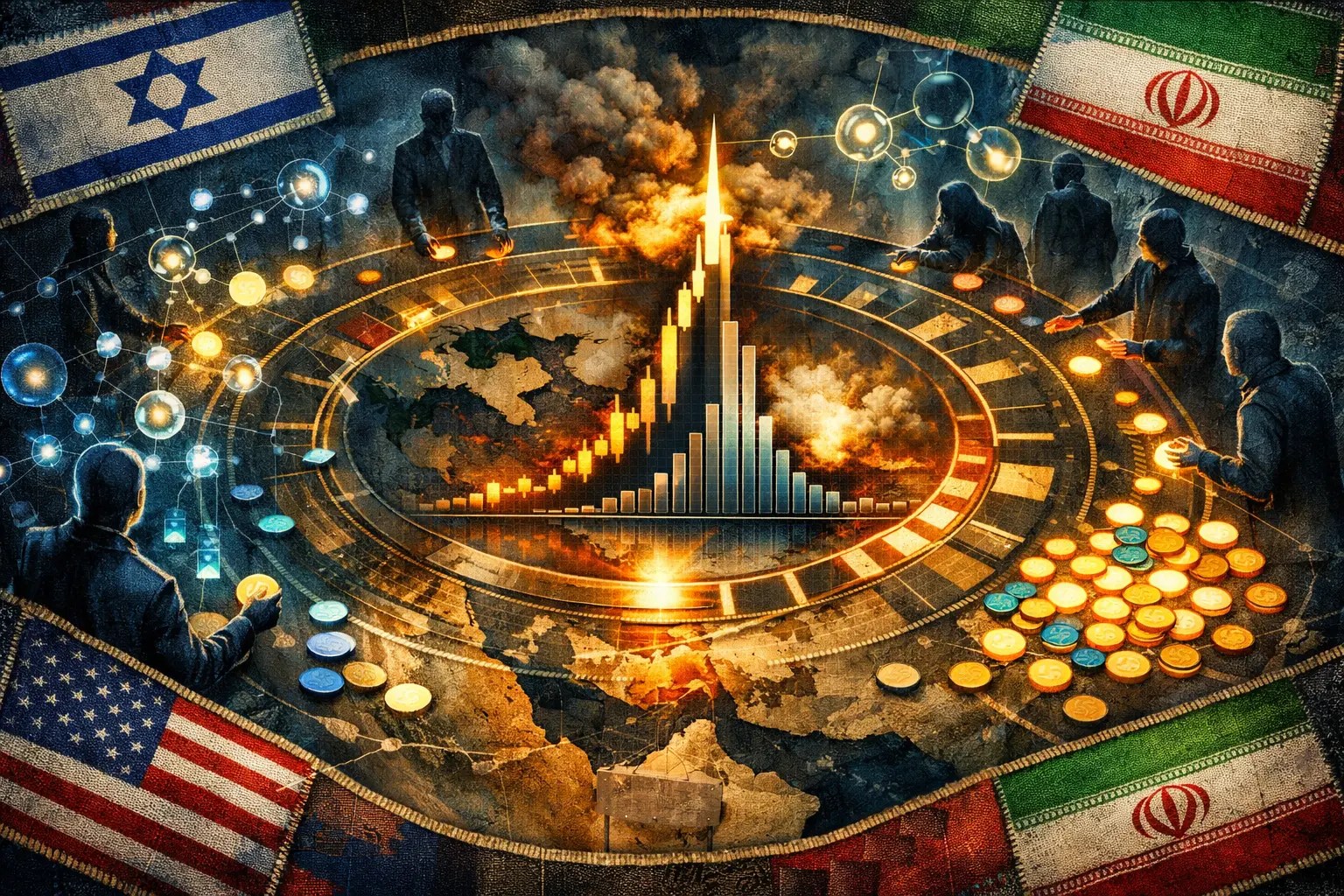
As U.S. and Israeli strikes hit Iran over the weekend, traders on Polymarket rushed to cash in on one of the biggest war-driven prediction markets seen in recent months. More than $529 million was traded across contracts tied to the timing of a strike, turning a military crisis into a fast-moving test of how prediction markets handle news, risk, and possible abuse.
The sharpest focus fell on one contract asking whether the U.S. would strike Iran by Feb. 28. That single market drew about $90 million in volume, far ahead of the next most active date, Jan. 31, which pulled in about $42 million. Another nearby contract for Feb. 27 also saw heavy activity. That tells a clear story in the price action: traders were not guessing at random. They were crowding around a tight time window, with money building around the dates that looked most likely as political tension rose.
Blockchain data then added a second layer to the story. Bubblemaps said six newly created wallets made about $1 million in combined profit by betting on a U.S. strike by Feb. 28. Some of the shares were bought for about 10 cents only hours before the first explosions were reported in Tehran. In prediction markets, a contract bought at 10 cents and resolved at $1 can return a gain of 90 cents per share. That kind of move is why timing matters so much. A small early position can turn into a large win if the market is right and the entry price is low.
Volume also matters here. Rising volume near one date often shows that traders believe new information is entering the market. It does not prove insider trading, but it can show where conviction is strongest. In this case, the high volume around Feb. 28 and the late buying near very low prices point to aggressive positioning. That is why these wallets drew attention. The pattern looked sharp, focused, and unusually well timed.
Still, the case is not simple. The U.S. had been signaling possible military action for weeks, and talk of a strike was already public. In a market filled with headlines, military leaks, and public threats, a trader can look brilliant without having secret information. At least one of the flagged wallets also lost money on an earlier wager before landing a much bigger win later. That weakens the idea that every successful trade came from inside knowledge.
This is where prediction markets run into their core problem. They are built to turn scattered information into a price. Supporters say that makes them useful. A rising contract can act like a live risk gauge when normal reporting lags or when officials stay vague. But the same system can reward people who act on private information before the public catches up. On crypto-based platforms, where a wallet can often trade with little public identity attached, that line gets hard to police.
The Iran markets showed how quickly that problem can spread beyond one contract. Traders also piled into bets tied to wider regional fallout, including whether another Gulf state would strike Iran and whether the U.S. would hit Iraq by the end of March. Those newer markets were still small, but they showed how fast a geopolitical shock can branch into a web of tradable outcomes.
The debate grew even sharper around leadership markets tied to Iran’s supreme leader. Critics said some contract wording could create a direct financial incentive around death, which crosses a moral line for many observers. Kalshi, a regulated rival, said it does not offer markets that settle on death and would instead resolve such a contract using the last traded price before that event. That contrast highlights the broader split in the industry: one side pushes open global betting on almost anything, while the other tries to keep tighter rules around what can be traded.
Recent criminal cases have made those concerns harder to dismiss. Israeli authorities recently brought what have been described as the first public criminal charges linking prediction-market bets to classified military intelligence. That case did not prove the same thing happened in the Iran strike market, but it showed that the risk is real, not theoretical.
For now, the Iran trade frenzy leaves behind a simple fact. Prediction markets can track public fear faster than most other tools. But when price jumps from 10 cents toward a full payout and volume explodes around a war deadline, the market is no longer just measuring belief. It is also raising the question of who knew what, and when.
