
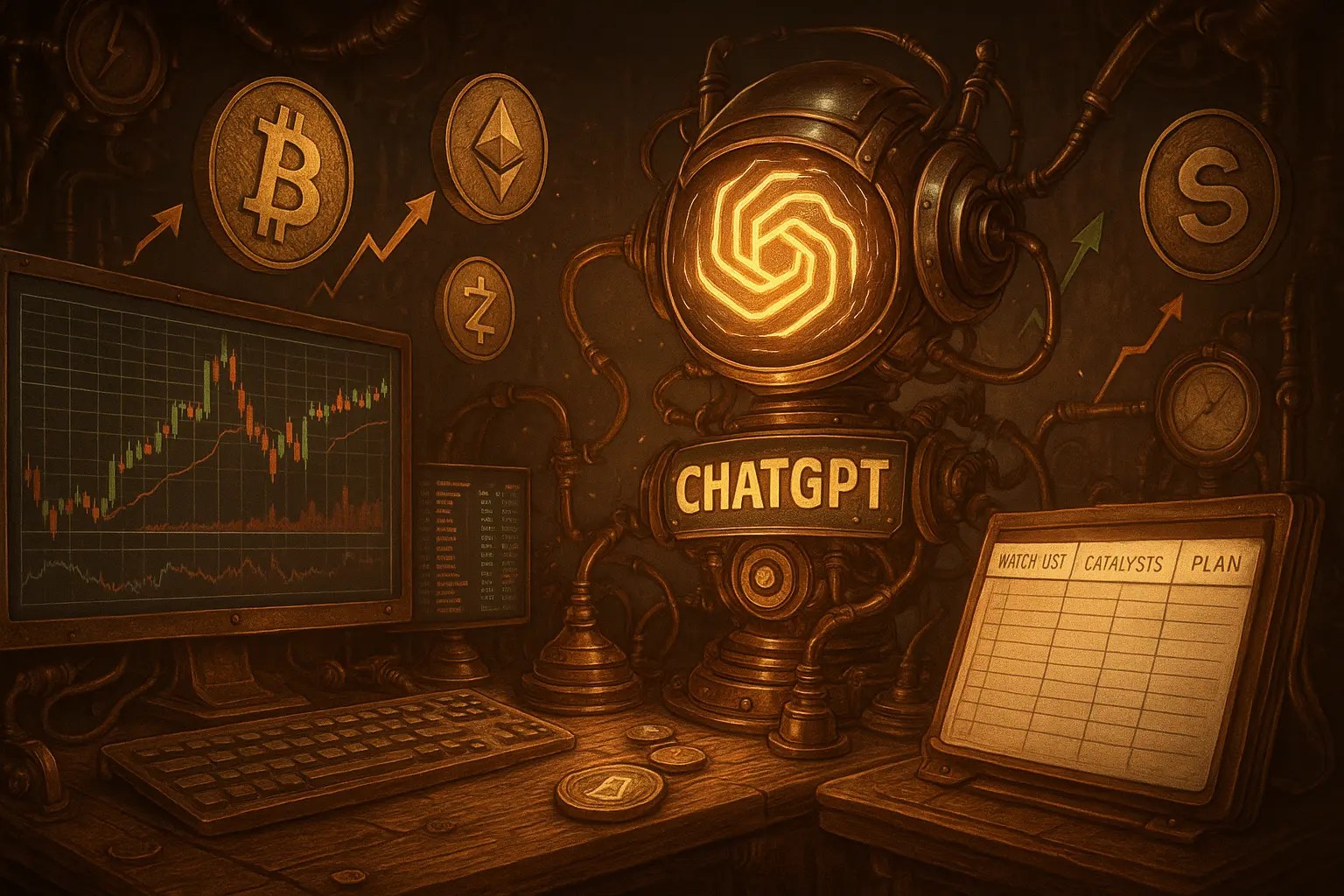
ChatGPT can help crypto day traders research and organize their ideas, but it cannot place trades. Traders use it to study strategies, compare coins, and manage discipline without handing over exchange keys. It works best when paired with live data from platforms like TradingView, Glassnode, or CryptoQuant because it cannot stream real-time prices. By using ChatGPT, traders create a simple system to filter noise, track watchlists, and turn raw market information into insights they can act on with confidence.
Day trading crypto means buying and selling within hours or even minutes. Unlike swing traders who hold for days or long-term investors who wait for months, day traders look for short moves. Crypto markets run 24/7, so a breakout can happen in the middle of the night. News spreads fast, and a token upgrade or a single post can change price direction instantly. Order books shift quickly, liquidity pockets open and vanish, and noise comes from Telegram, Discord, X, and onchain alerts. ChatGPT acts as a co-pilot. It does not replace the trader, but it helps cut through overload, summarize order flow, and focus on real catalysts that move prices.
One of the strongest uses of ChatGPT in trading is reasoning over long context. It can process up to a million tokens, which means you can paste in entire news feeds, research notes, and OHLCV data in one prompt. Traders then ask it to find key resistance and support levels, identify repeated price rejections, or summarize liquidity gaps. Instead of scanning dozens of charts, ChatGPT produces a clear text summary that highlights critical levels like Bitcoin at $105,000 or Ether near $3,950. For order flow, it can explain whether futures positions lean long, short, or neutral based on open interest and funding rates that the trader provides.
ChatGPT also supports discipline. A simple trading notebook in Google Sheets can have six tabs: Watchlist, Catalysts, Levels, Order Flow, Plan, and Post-Mortem. Traders feed ChatGPT data for each tab and then prompt it to generate structured scenarios. For example, it might outline that Ether breaks above $3,000 on volume and offers a scalp long with stops at $2,960. It can warn if Solana shows weakness after a token unlock and suggest a short entry. After trades close, ChatGPT can review results. It might find that a trader cuts winners too early, lets losers run, or overtrades during volatility. This creates a repeatable loop that improves discipline and reduces emotional trading.
Risk management is where ChatGPT becomes a strong assistant. Day trading crypto is risky, and survival depends on sizing positions correctly and planning for all outcomes. Traders can ask ChatGPT to calculate position sizes based on account size and leverage. They can request three scenarios for each setup, including bullish, bearish, and sideways cases. By ranking setups with risk-to-reward ratios, the model keeps focus on trades with the best return compared to potential loss. Traders can also check their capital allocation by asking ChatGPT to show if they hold too much exposure to assets that move together, like Ether and other high-beta tokens.
Catalyst filtering is another valuable use. Traders paste in news headlines or social media posts, and ChatGPT highlights which are most likely to affect Bitcoin, Ether, or Solana based on past reactions. Instead of scrolling through hundreds of updates, traders get a focused list of events to watch. This is important because crypto narratives shift fast, and only a few catalysts actually move the market. ChatGPT reduces noise so traders can act on signals, not rumors.
Developers can go further with ChatGPT through Google AI Studio and the API. By scripting prompts, they integrate AI into dashboards, backtesting tools, or trading journals. In Google Workspace, ChatGPT works inside Docs and Sheets to summarize data, clean text, and build charts. Even no-code traders can use in-cell AI functions to turn raw numbers into simple visuals or rankings. This makes it easier to run daily trading loops without switching between ten platforms.
It is important to remember what ChatGPT should not do. It should not hold crypto keys or trade automatically. Traders keep it focused on analysis, alerts, and simulation. When linked to exchange APIs, permissions must stay limited. The AI assists with reasoning and structuring, but humans remain in control of orders. This prevents costly mistakes and ensures safe use of the technology.
ChatGPT cannot replace real-time feeds. Traders still need live charts and order book data from platforms like TradingView and Glassnode. The AI helps organize and summarize, but decisions must always be checked against current market conditions. Crypto is volatile, and no tool removes risk. Traders still need to do their own research, plan carefully, and accept that losses are part of the game.
Day trading with ChatGPT is about working smarter. Instead of chasing signals and reacting to noise, traders use AI to manage watchlists, filter catalysts, structure trading plans, and review mistakes. It does not provide shortcuts but gives clarity and structure. With discipline, planning, and risk control, ChatGPT helps traders survive fast markets and improve their strategies over time.
