
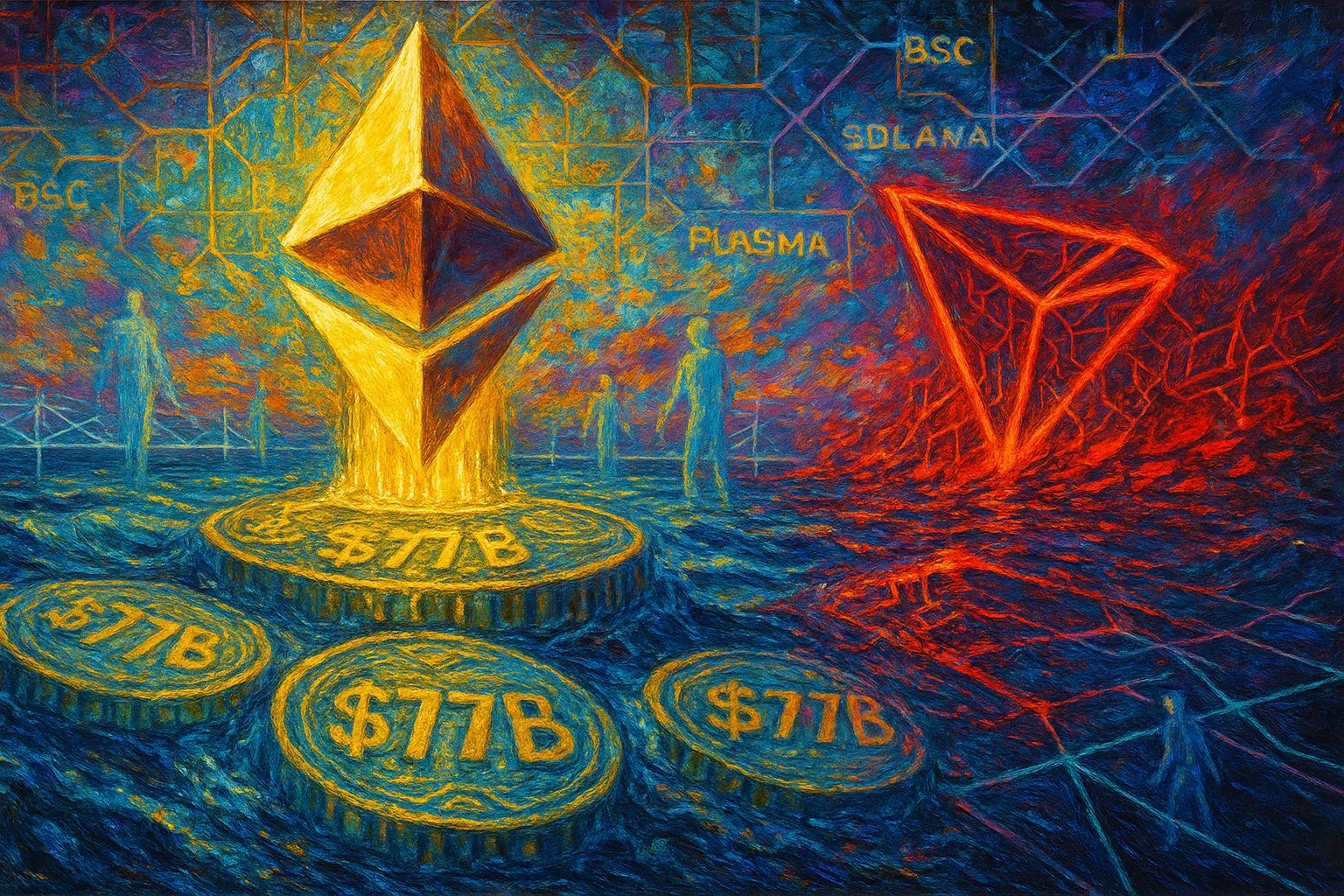
Ethereum has taken back the lead as the largest blockchain for USDT supply, moving ahead of Tron after months of close competition. The supply of USDT on Ethereum has grown by about $17 billion since May, reaching around $77 billion. Tron now holds about $76.2 billion, according to DeFiLlama data, showing how narrow the gap remains between the two networks.
For much of the year, Tron and Ethereum traded places for the top spot. In May, Tron held 48% of the USDT market compared to Ethereum’s 42%. Since then, institutional adoption has shifted the balance in Ethereum’s favor. Retail traders often turn to Tron because of its low fees, but Ethereum has kept strong liquidity and a broad DeFi ecosystem. Other chains hold smaller shares, with BSC at 7.5%, Plasma (XPL) at $4.37 billion, and Solana around $2.1 billion.
Ethereum now processes about 400,000 daily USDT transactions, while the overall network handles more than 1.6 million transactions a day. Tron still records more transactions, but Ethereum has become the preferred choice for large-scale transfers and institutional settlement. The scale of USDT supply on Ethereum drives cross-chain bridge use, liquidity provision, and exchange integration. This positions Ethereum as the main settlement layer for financial firms adopting blockchain payments.
Institutional adoption plays a major role. Companies like PayPal have integrated their PYUSD stablecoin on Ethereum, adding more than $1.7 billion in supply. These moves signal trust in Ethereum as the base layer for regulated stablecoins and financial applications. Analysts note that while Ethereum’s transaction fees are higher than Tron’s, institutions value the deeper liquidity and compliance-ready infrastructure that Ethereum provides.
Tether remains the global leader in the stablecoin market with a market cap of about $174 billion. Circle’s USDC follows with around $74 billion. Together, the two dominate stablecoin markets, but their strategies differ. Tether, launched in 2014 under the name RealCoin, built its lead by offering fast settlement and lower fees across more than 90 networks. It has also faced controversies over its reserves and fines from regulators. Circle’s USDC, introduced in 2018, has focused on compliance and transparency. It publishes monthly reserve attestations and works closely with U.S. financial institutions. Circle went public in June on the New York Stock Exchange, raising over $1 billion in its IPO.
The U.S. regulatory landscape is also shaping competition. The GENIUS Act, signed into law in July, set clear standards for stablecoins. It requires monthly public reserve disclosures, independent audits, and strict limits on asset holdings. Circle already follows most of these rules. Tether is now launching a new U.S.-compliant token called USAT while continuing to issue USDT for the global market.
Tether has remained profitable despite scrutiny. It has reported billions in quarterly earnings, mostly from its holdings of U.S. Treasuries. The company is now among the largest private holders of U.S. debt, with more than $24 billion in Treasury bills. Circle, while trusted for transparency, faces slower growth because of its revenue-sharing model with banking partners.
The rivalry between Ethereum and Tron reflects a broader stablecoin race. Retail users still choose Tron for everyday transfers because of low fees, while institutions and DeFi projects lean toward Ethereum for its stability and network depth. With new regulations, stablecoins are moving closer to mainstream finance. Analysts point out that Ethereum’s ability to attract institutional flows through USDT and USDC will shape its role as a settlement layer for global payments.
As the stablecoin market expands, questions remain about long-term dominance. Tron continues to provide an efficient platform for retail users. Ethereum, backed by institutions and compliance-driven growth, may solidify its position as the main home for stablecoins. With Tether and Circle competing on scale and regulation, the market will likely remain divided. What is clear is that stablecoins have become central to crypto liquidity, bridging traditional finance and digital assets while powering DeFi and payments worldwide.
