Ethereum has been moving higher in price and showing strength on its own. Many people expect it to follow Bitcoin, but ETH has built its own path. Institutional investors, including funds and companies, are buying Ethereum because they see long-term value. This accumulation shows confidence that ETH is not only important today but will remain important in the future. Ethereum powers decentralized finance, NFTs, stablecoins, and staking rewards, making it one of the most used blockchains. This strong ecosystem supports real utility and adoption.
Staking ETH has become popular because it offers consistent rewards. People who stake ETH lock their coins to help run the network and earn yield in return. For many, this is a steady source of passive income. Both retail traders and institutional investors are drawn to this, as it offers better returns than traditional savings accounts. The deflationary supply from EIP-1559, combined with staking, makes Ethereum more scarce. Scarcity can support higher prices over time. With fewer coins available and demand increasing, many analysts believe ETH could rise to new all-time highs.
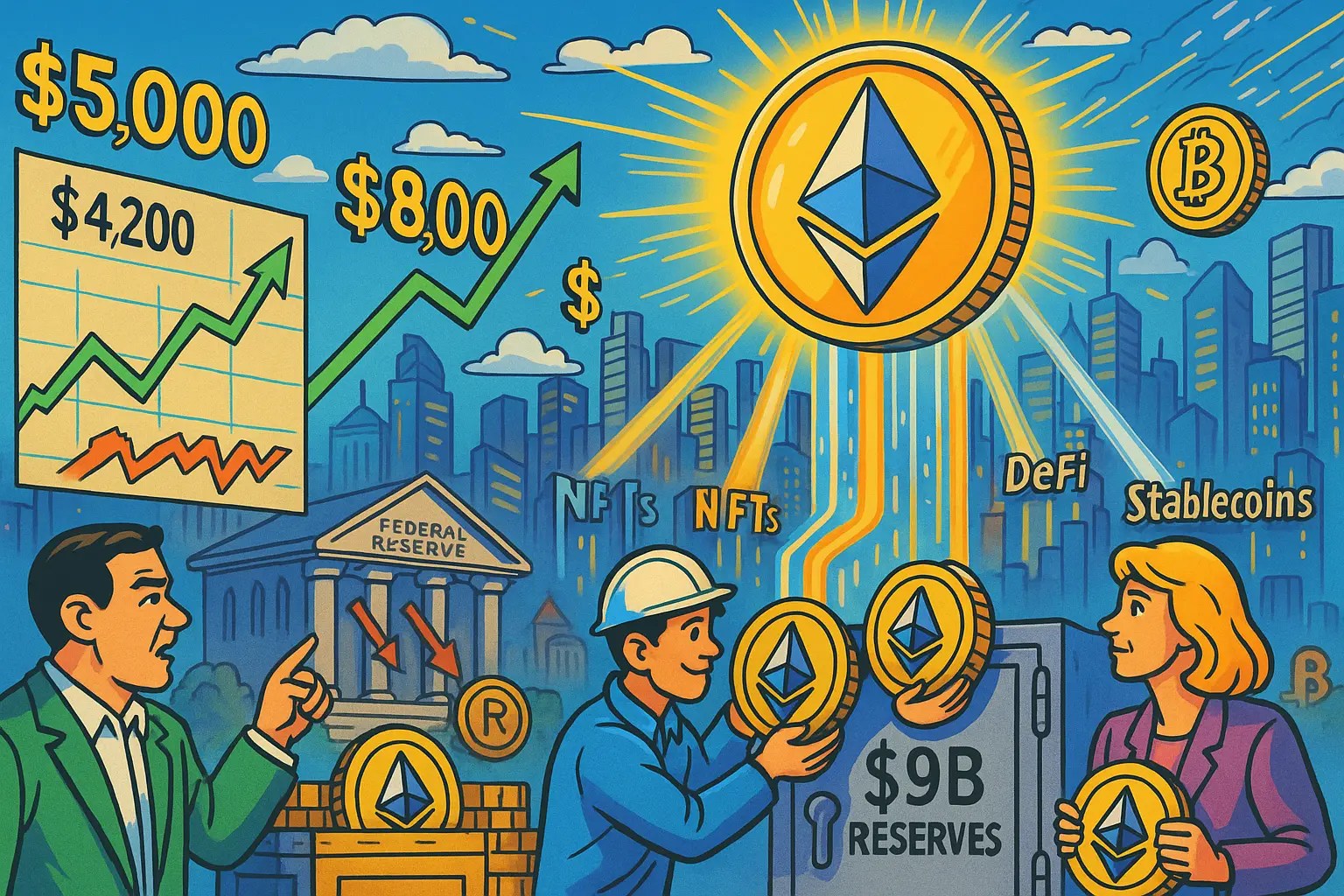
Ethereum has been trading in a range between $4,200 and $4,500 after reaching $4,956 in August. This consolidation has given traders time to study the market. Analysts discuss the possibility of ETH reaching $5,000 soon, and some even say $8,000 is realistic if momentum continues. ETH has held strong against Bitcoin dominance, showing only a 2% drop year over year. This resilience shows Ethereum can stand on its own and is not just Bitcoin’s little brother. The ETH/BTC pair is watched closely because it signals whether Ethereum is gaining strength compared to Bitcoin.
Institutional investors keep adding ETH despite a decline in on-chain activity. Bitmine Immersion Tech recently added over 200,000 ETH, worth almost $880 million, to its balance sheet. The company now holds more than $9 billion in Ethereum. These purchases reflect long-term belief in ETH as a reserve asset. Even when daily blockchain activity slows, large buyers continue to invest. For them, Ethereum is not only about short-term trading but also about its role in powering Web3. As more rollups, zk technology, and account abstraction features develop, ETH stays central to scaling the internet of the future.
The macroeconomic environment also affects Ethereum’s price. The S&P 500 recently reached a new all-time high after weaker labor market data raised expectations of Federal Reserve interest rate cuts. When interest rates fall, investors look for other assets that can offer better returns, and Ethereum is one of them. Traditional stocks can offer dividends and buybacks, acting like gold as a store of value. Ethereum, however, still carries more risk but also more potential. If economic uncertainty decreases, ETH could reach $5,000 or higher as investors search for growth. Traders understand that ETH’s path is tied both to global markets and to its own adoption.
Ethereum is also the backbone for stablecoins, DeFi protocols, and NFTs. Most activity in decentralized finance happens on Ethereum’s network or its Layer 2 solutions. These applications create sticky demand that is hard to replace. People borrow, lend, and trade billions of dollars on Ethereum every day. NFTs continue to rely on Ethereum’s security, and stablecoins use it as their base. This wide use adds to the long-term case for ETH. Unlike many other blockchains that come and go, Ethereum has built deep infrastructure that holds users and developers in place.
The deflationary design of Ethereum is another key point. Since EIP-1559, part of every transaction fee gets burned, reducing total supply. Combined with staking, this creates structural scarcity. When supply falls and demand rises, price usually follows. This is why many analysts predict that Ethereum will not only reach $5,000 but could climb to $8,000 in the coming years. The narrative is shifting, and ETH is becoming recognized as the foundation of Web3. It is seen as infrastructure, like roads or power grids, but for digital finance and applications.
Ethereum’s role is not only about speculation. It is about real adoption. From institutional balance sheets to everyday users staking for income, ETH shows strength in both areas. Analysts, traders, and long-term holders agree that Ethereum has its own identity, separate from Bitcoin. With consistent staking rewards, strong institutional demand, and a scarce supply, ETH is positioned to lead the next stage of the crypto market rally. Investors who watch Ethereum see it as both a technology platform and a financial asset that can grow in value over time.
Ethereum has moved from being a risky experiment to becoming a powerhouse. Its price targets of $5,000 and $8,000 may sound ambitious, but they are backed by real activity and adoption. The Ethereum ecosystem continues to expand with rollups, zk technology, and improvements in scalability. Its role in DeFi, NFTs, and stablecoins makes it essential to Web3. As institutional accumulation grows and the global economy shifts, Ethereum shows why it is more than Bitcoin’s little brother. It is a leading force with its own momentum, ready to prove its strength in the market once again.
