
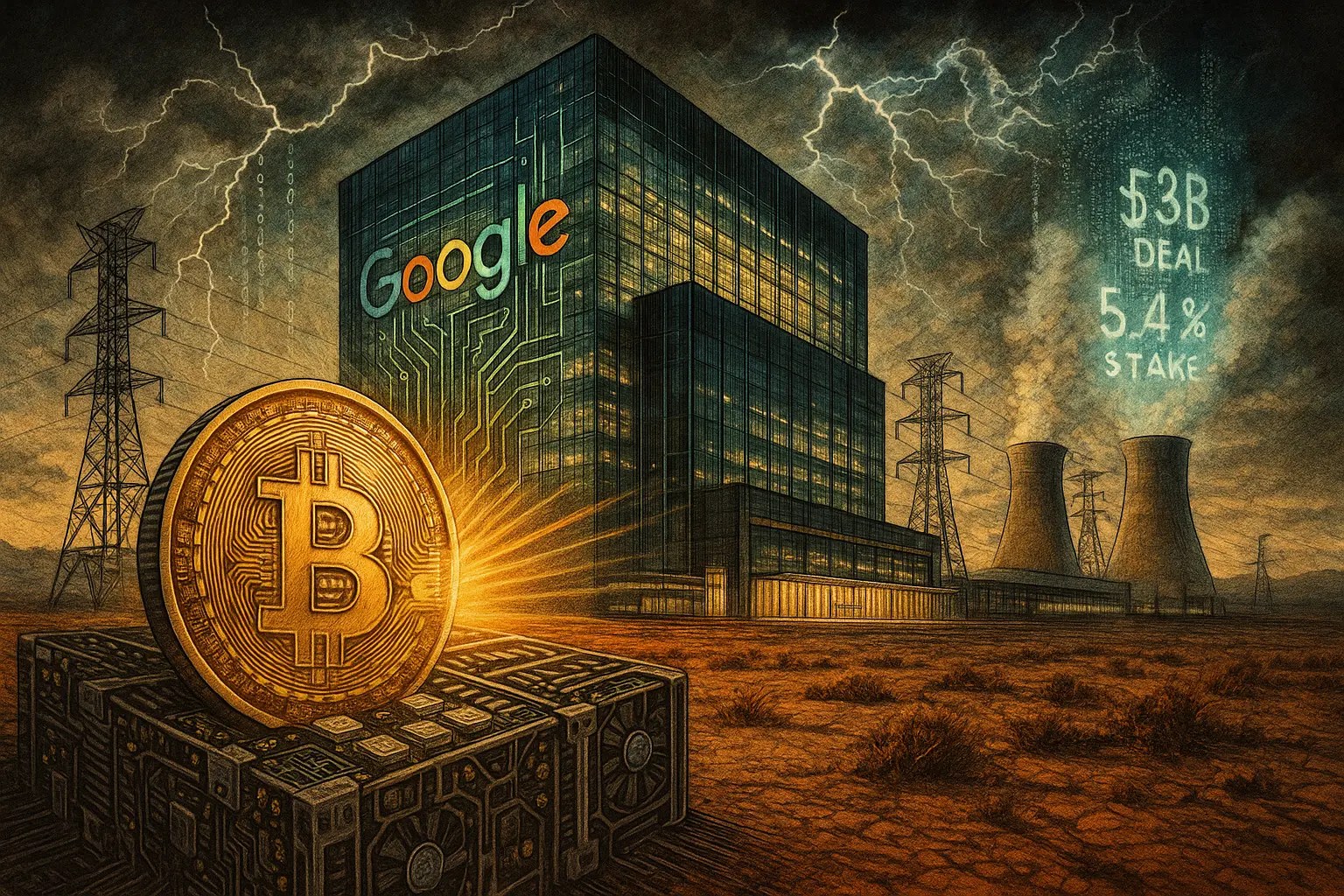
Google has taken another step into the world of Bitcoin mining and artificial intelligence. The company has agreed to backstop $1.4 billion of obligations owed by Fluidstack, a cloud computing firm, in exchange for a 5.4% stake in Bitcoin miner Cipher Mining. The deal is part of a much larger $3 billion, 10-year agreement between Fluidstack and Cipher Mining to lease computing power for high-performance computing, or HPC, at Cipher’s Barber Lake site in Colorado City, Texas.
Cipher Mining will provide 168 megawatts of computing power to Fluidstack, with the potential to expand to 244 MW of gross capacity at the site. The Barber Lake facility can reach up to 500 MW if expanded, and it sits on 587 acres of land that allows for future growth. This site is now one of the most important projects in the growing crossover between Bitcoin mining and artificial intelligence data centers. Under the agreement, Cipher expects about $3 billion in revenue over the first 10 years, with the possibility of extending the contract twice for five years each. If exercised, those options would bring the deal’s total value to about $7 billion.
Google will receive warrants to buy around 24 million shares of Cipher Mining’s stock. That amounts to about a 5.4% pro forma equity ownership stake in the company. The structure is similar to a deal Google struck in late August, when it acquired a 14% stake in Bitcoin miner TeraWulf. Both deals involve Fluidstack and show how the company uses its AI data center business to build partnerships with major technology and mining firms.
Cipher’s CEO Tyler Page said the deal reflects the company’s momentum in the HPC sector. He believes this transaction is the first of several that will support growth in high-performance computing as miners look for ways to diversify. Fluidstack’s co-founder César Maklary said his company is focused on delivering computing infrastructure for frontier AI firms, and this partnership with Cipher and Google strengthens that effort.
The trend of crypto miners entering AI services has been gaining pace. CleanSpark recently raised $100 million for AI infrastructure, while Hive Digital has expanded into GPU and AI services. Earlier this year Hive Digital reported record revenue and earnings, helped by its pivot into artificial intelligence. Bitcoin mining companies have been rewarded by investors for diversifying into AI computing, with stocks often rising faster than Bitcoin itself when firms announce GPU-based projects.
Cipher Mining is positioning itself as a major player in both Bitcoin mining and AI data centers. The deal provides critical capital support, since Google’s $1.4 billion backstop allows Fluidstack to meet lease obligations that support project financing. This structure helps Cipher retain 100% ownership of the Barber Lake project while still funding the large expansion costs. Building high-performance computing facilities can cost $9 to $11 million per megawatt, making outside financing essential. Cipher’s projected site margin is expected to reach 80% to 85% once operations scale.
For Google, the deal reflects a strategy of gaining exposure to Bitcoin mining and AI infrastructure without directly operating mining facilities. By acquiring equity stakes in Cipher Mining and TeraWulf, Google positions itself as a backer of firms that supply computing resources for both blockchain and artificial intelligence. It also connects the company with Fluidstack, which provides AI cloud platforms and builds HPC clusters for some of the world’s largest technology companies.
Cipher Mining’s Barber Lake project is one of the largest industrial-scale data center sites under development in the United States. With its ability to deliver hundreds of megawatts of computing power, the site is well suited to handle the demands of both Bitcoin mining and AI workloads. The 10-year colocation agreement with Fluidstack locks in a steady revenue stream, while Google’s equity stake shows confidence in Cipher’s role as a long-term provider of next-generation computing.
The growing partnership between tech giants, Bitcoin miners, and AI firms highlights how the boundaries between industries are changing. What started as Bitcoin mining is now becoming part of the infrastructure that trains artificial intelligence models. Miners with large data centers and access to cheap energy are finding new ways to generate revenue beyond cryptocurrency. Investors are watching closely as companies like Cipher Mining, TeraWulf, Hive Digital, and CleanSpark continue to expand into AI, GPU computing, and HPC services.
Google’s move to acquire a 5.4% stake in Cipher Mining by backstopping $1.4 billion of Fluidstack’s obligations shows that the future of computing is not only about Bitcoin or AI alone. It is about how both industries use the same resources: power, land, and infrastructure. With a $3 billion contract and the potential to grow into a $7 billion project, the partnership at Barber Lake is set to play a central role in the evolving crossover between crypto mining and artificial intelligence data centers.
