
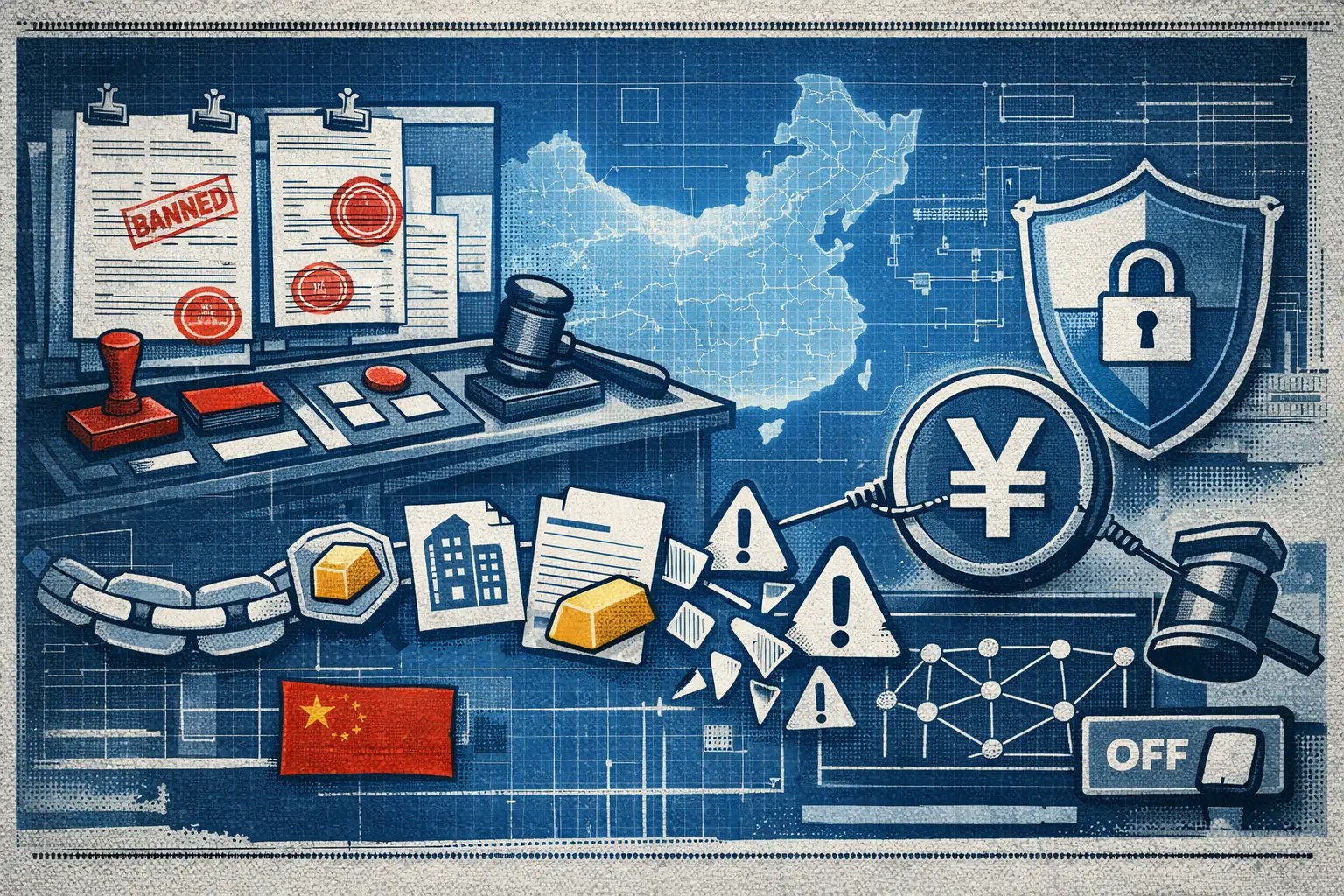
China’s regulators issued a new notice on February 6, 2026, aimed at tightening control over virtual currency activity and the growing push to turn real-world assets into blockchain tokens. The document was signed by the People’s Bank of China and several other agencies, and it frames virtual currency business as an illegal financial activity inside China.
The notice repeats a core message: virtual currency is not legal tender. It names common coins like Bitcoin, Ether, and Tether as examples of virtual currency that cannot be used as money in the market. Under the new rules, trading services for virtual currency remain off-limits. That includes exchanging fiat for virtual currency, swapping one virtual currency for another, running a central counterparty that buys and sells virtual currency, and offering pricing or matchmaking for virtual currency trades. Token fundraising tied to virtual currency is also barred. The notice also warns overseas players not to provide virtual currency services into China.
At the same time, regulators put a bright spotlight on real-world asset tokenization, often called RWA tokenization. This is when a company uses blockchain tools to turn rights tied to an asset—like ownership or income rights—into a token that can be issued and traded. The notice says RWA tokenization done inside China, or supported from inside China, can cross into the same legal risk zone as virtual currency deals. The concern is that some RWA tokenization schemes can look like unapproved securities, illegal fundraising, or other banned finance activity. Regulators leave a narrow door open only for approved pilots that run through specific regulated financial infrastructure.
Stablecoins get special attention. The notice says a stablecoin pegged to a fiat currency can act like money in daily use, even if it is branded as a token. It states that no one may issue a stablecoin linked to the renminbi without approval, even if the issuance happens outside China. This point matters because stablecoins often serve as the bridge between trading accounts and virtual currency markets. Cutting off a renminbi-pegged stablecoin reduces a path for moving funds into virtual currency trading.
The notice also tries to tighten the “plumbing” that supports virtual currency and RWA tokenization. Financial institutions and payment firms are told not to open accounts, move funds, or provide clearing and settlement for virtual currency business. They also cannot sell virtual currency-linked products, accept virtual currency as collateral, or write insurance tied to virtual currency. For unapproved RWA tokenization, custody and settlement services are also restricted. In plain terms, the rules aim to make it harder for virtual currency flows to touch the banking system.
Internet platforms are pulled into the enforcement plan. The notice says online firms cannot offer hosting, marketing, paid traffic, or other support for virtual currency and RWA tokenization schemes. If a platform finds signs of a virtual currency operation, it must report it and help with investigations. Regulators also say they can shut down websites, apps, mini-programs, and social accounts tied to virtual currency promotion or sales. This is designed to reduce the reach of virtual currency ads and cut off new users before they are pulled into risky offers.
Market regulators are told to block branding that normalizes the space. The notice says business registrations and business scopes should not include terms like “virtual currency,” “crypto asset,” “stablecoin,” “RWA,” or “real-world asset tokenization.” It also calls for stricter checks on advertising tied to virtual currency and RWA tokenization. The goal is to limit storefront-style signals that make virtual currency activity look permitted.
Mining returns as a key target. China already moved against crypto mining in earlier campaigns, but the notice calls for continued cleanup. It says provinces should find and shut down remaining mining projects, stop new mining projects, and prevent mining machine makers from offering sales services inside China. Mining matters because it can create large, hard-to-trace virtual currency flows and can also stress local power grids.
One of the strongest lines is about legal protection. The notice states that investing in virtual currency, RWA tokens, or related products can be treated as violating public order and good morals, making the civil act invalid and leaving losses with the investor. A similar warning appeared in China’s 2021 notice on virtual currency trading risk, and it signals that courts may not help someone recover money lost in a virtual currency deal.
The cross-border section ties the themes together. China is not only watching virtual currency at home, but also watching how domestic firms use offshore structures. The notice says domestic entities and their controlled overseas entities cannot issue virtual currency abroad without approval. It also says tokenized deals tied to onshore assets—such as tokenized asset-backed structures—will face strict filing and review by agencies like the CSRC, with a “same business, same risk, same rules” approach. That keeps RWA tokenization from becoming a back door for virtual currency-style fundraising.
For enthusiasts, the message is clear: China is drawing a hard line around virtual currency while trying to keep tighter control over any form of tokenized finance that looks like a security. Virtual currency trading, virtual currency marketing, and virtual currency payment rails remain the main targets. RWA tokenization is not treated as a free pass, and stablecoin plans tied to the renminbi face a direct ban without approval.
